2025: dive into another universe.
Chance guides the tool, the eye, the meaning. Technique creates the writing. The subject emerges from the improbable. It’s like a new friend we make room for in our lives.
I’ve always found that pictorial techniques lead me to the subjects, not the other way around. By experimenting with the cold wax medium, I discovered a new interest: the richness of night scenes, urban interiors and exteriors, desolate, deserted. Almost. In these particular hours of the night, life is in flux; our gaze has only artificial light as a guide. Even if a shadow bears witness to a barely identifiable human presence, the absence is imposing.
This new series is expressed in chiaroscuro. A return to my painting roots. Shadow and light. Raw. Confronted. Sublimated.
It’s all about pareidolia. Here’s what the great Leonardo observed:
“[…] if you look at walls soiled with many stains, or made of multicolored stones, with the idea of imagining some scene, you will find there the analogy of landscapes with mountains, rivers, rocks, trees, plains, broad valleys, and hills of all kinds. You will also be able to see battles and figures with lively gestures, strange faces and costumes, and an infinite number of things, which you will be able to reduce to a clear form and complete.” Leonardo da Vinci, Treatise on Painting.
I’m enjoying this new subject. It opens up so many possibilities. And since not everyone sees faces in the clouds or horses on the rocks, the titles of the works will guide the viewer. And too bad if they only see stubborn abstraction. What remains is light and shadow. No need to identify any realism to appreciate them.
The deliberate choice of dark colors and warm hues creates unique atmospheres.
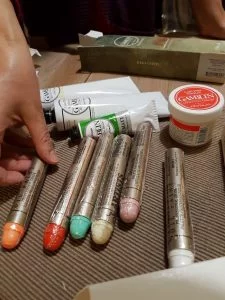
For me, changing artistic interests goes hand in hand with a change in technique. Cold wax medium is not encaustic. It acts cold as a thickening texturizer for oil paint. The soft paste is then applied to the surface with a brush or spatula. This medium gives a matte surface that can be patinated with a lint-free cloth if you prefer a satin finish. My night scenes are done in oil on paper. I use Bristol papers, watercolor papers in different weights, and special papers for oil. When the papers are not intended for oil, I prime them with gesso. Or with alcohol-based shellac varnish. Shellac is “a lacquer derived from the secretion of an Asian cochineal, Kerria lacca.” This resin is used in cabinetmaking for polishing with a French polish. But it’s also used to prepare artistic papers. I like this painter’s “kitchen.”
Urban night scenes, night lights. From sunset, a lot happens: from elegant riots to nighttime cafes in buildings and sketched skylines, nighttime cafes and the ruminations of the lonely, restaurants in the evening with their last customers leaving, then closed establishments, scrubbed kitchens, ready for the next day’s fire. Warehouses, freight elevators, elevators, factories without light. And all the absentees who leave only the shadows that followed them.
This intimate yet urban universe requires a different mindset than the plant interpretation. The palette is limited, in Indian yellow, umber, and burnt sienna. I will soon post this universe online, which takes me back to my first loves at the Beaux-Arts: monotype, drypoint engraving, and etching.
The colorful journey through flowers is not over. But the foray into the land of “chattering forms” opens a new path, in chiaroscuro, a delight between shadows and lights.