“Oh, that reminds me of that!” “Oh, it looks like that!” …
We’ve all heard these remarks, disappointed and heartbroken, in front of abstract paintings, even if they’re not so abstract.
Irritating little phrases, like mosquitoes on a summer evening, for us artists, capable of detachment from representation, elevated to the art of possessing Art (with a capital A, mind you).
“What! These scoundrels are incapable of appreciating only shapes or colors!” we grumble, frowning and not very kindly looking, as if recognizing nothing in more or less abstract forms were the pinnacle of honorable appreciation of the art of image-making.
I too got annoyed earing those words, oh, very little, in truth.
Because, like so many others, I am a major “victim” of pareidolia.
Not everyone is prone to it. It’s like immunity to viruses. Not everyone possesses it.
Yes, it takes imagination, a capacity for reconstructing reality, and—counterintuitively—a capacity for abstraction to extricate the silence of walls, clouds, or paintings, landscapes, objects, and figures.
In my new work, I give voice to these reflections considered naive. I give substance to this reality, shaped by its rough edges and interlacing. I affirm it. I summon it.
Let us not forget the reflections of the great Leonardo, and his ability to see battles on stone walls.
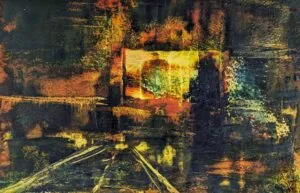
Now, I am the first to utter the hated reflections in front of my cold wax oil paintings. I will dig into the material, I knead, I massage, I spread and blend, searching for reality in the inanimate shapes and colors offered, often hidden, on the paper. And when I’ve found it, I give the joyful nudge that triggers the “Oh, it seems like that.”
So I will attach importance to the title of the work. It will be the confirmed exclamation. For, in this new dizzying universe beneath my feet, like a pocket of shadow and light at the bottom of a ravine, my words must unfailingly guide the gaze, seek its approval. The balance is precarious.
Indoor or outdoor night, like in the movies, this series of nocturnal scenes, where the fleeting and overwhelming image is framed on the screen of our dark nights, came about as if by chance. Without looking for anything, just by doing. In the blink of an eye.
And, at a future exhibition of these works on paper, I hope to hear: “Oh, it looks like this, or that!” If my ear catches humans saying these words, I will know that I have succeeded in holding this project on the edge. Against the grain of the elitist pictorial universe, I will have drawn everything from nothing.


Privacy Overview
This website uses cookies to improve your experience while you navigate through the website. Out of these, the cookies that are categorized as necessary are stored on your browser as they are essential for the working of basic functionalities of the website. We also use third-party cookies that help us analyze and understand how you use this website. These cookies will be stored in your browser only with your consent. You also have the option to opt-out of these cookies. But opting out of some of these cookies may affect your browsing experience.
Powered by